
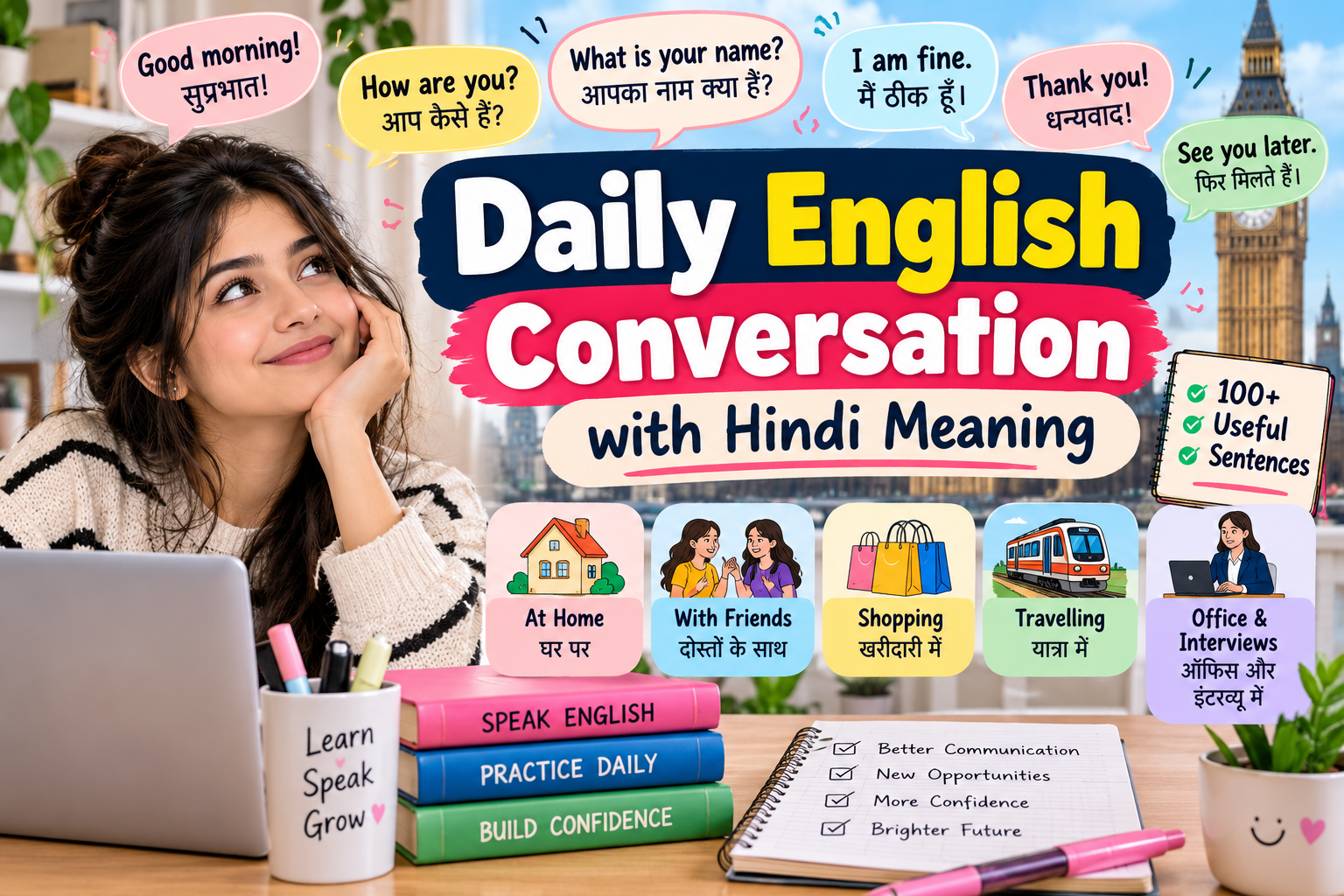
Learning English becomes easier when you practice speaking it in everyday situations. Many Hindi-speaking learners understand basic English but feel nervous when they need to speak with others. The best way to improve your communication skills is to learn common English sentences and use them in daily conversations.
In this guide, you will learn daily English conversation with Hindi meaning, including greetings, conversations at home, shopping, travelling, talking to friends, and workplace communication. These simple English sentences are suitable for beginners who want to improve their spoken English at home.
Why Is Daily English Conversation Important?
Daily conversation practice helps you learn how people actually speak English in real life. Instead of memorizing complicated grammar rules, you can start with short sentences and gradually build your confidence.
Here are some benefits of practicing daily English conversations:
- Improves speaking confidence.
- Helps you learn useful English vocabulary.
- Makes it easier to understand everyday conversations.
- Improves pronunciation through regular speaking practice.
1. Daily English Greetings with Hindi Meaning
Greetings are the first step toward starting a conversation in English.
| English Sentence | Hindi Meaning |
|---|---|
| Good morning! | सुप्रभात! |
| How are you? | आप कैसे हैं? |
| I am fine. | मैं ठीक हूँ। |
| What is your name? | आपका नाम क्या है? |
| My name is Rahul. | मेरा नाम राहुल है। |
| Nice to meet you. | आपसे मिलकर अच्छा लगा। |
| How have you been? | आप कैसे रहे हैं? |
| What are you doing? | आप क्या कर रहे हैं? |
| Where are you from? | आप कहाँ से हैं? |
| See you later. | फिर मिलते हैं। |
Example conversation:
A: Hello! How are you?
Hindi: नमस्ते! आप कैसे हैं?
B: I am fine. What about you?
Hindi: मैं ठीक हूँ। आप कैसे हैं?
A: I am doing well, too.
Hindi: मैं भी अच्छा हूँ।
2. Daily English Conversation at Home
You can practice these sentences while talking to family members.
| English Sentence | Hindi Meaning |
|---|---|
| Have you eaten? | क्या आपने खाना खा लिया? |
| What are you cooking? | आप क्या बना रहे हैं? |
| I am feeling hungry. | मुझे भूख लग रही है। |
| Please give me some water. | कृपया मुझे थोड़ा पानी दीजिए। |
| I am getting ready. | मैं तैयार हो रहा/रही हूँ। |
| Where is my phone? | मेरा फोन कहाँ है? |
| I will be back soon. | मैं जल्द वापस आऊँगा/आऊँगी। |
| Please open the door. | कृपया दरवाज़ा खोलिए। |
| I am feeling sleepy. | मुझे नींद आ रही है। |
| Let us have dinner. | चलिए, रात का खाना खाते हैं। |
3. English Conversation Between Friends
These sentences are useful when talking to your friends in everyday situations.
| English Sentence | Hindi Meaning |
|---|---|
| What is the plan for today? | आज का क्या प्लान है? |
| Are you free today? | क्या तुम आज खाली हो? |
| Let us go out. | चलो बाहर चलते हैं। |
| I was thinking about you. | मैं तुम्हारे बारे में सोच रहा/रही था/थी। |
| That sounds great! | यह तो बहुत अच्छा लग रहा है! |
| Do not worry. | चिंता मत करो। |
| I will call you later. | मैं तुम्हें बाद में फोन करूँगा/करूँगी। |
| Why are you laughing? | तुम क्यों हँस रहे हो? |
| I totally agree with you. | मैं तुमसे पूरी तरह सहमत हूँ। |
| Let me know. | मुझे बता देना। |
Example conversation:
A: Are you free this evening?
Hindi: क्या तुम आज शाम खाली हो?
B: Yes, why?
Hindi: हाँ, क्यों?
A: Let us go for a walk.
Hindi: चलो टहलने चलते हैं।
B: That sounds great!
Hindi: यह तो बहुत अच्छा है!
4. English Sentences for Shopping
Shopping is a useful situation in which to practice English speaking.
| English Sentence | Hindi Meaning |
|---|---|
| How much does this cost? | यह कितने का है? |
| Do you have another size? | क्या आपके पास दूसरा साइज़ है? |
| Can I try this on? | क्या मैं इसे पहनकर देख सकता/सकती हूँ? |
| Is there any discount? | क्या कोई छूट है? |
| This is too expensive. | यह बहुत महँगा है। |
| Please show me another one. | कृपया मुझे दूसरा दिखाइए। |
| I will take this one. | मैं यह वाला ले लूँगा/लूँगी। |
| Can I pay by UPI? | क्या मैं UPI से भुगतान कर सकता/सकती हूँ? |
| Please pack this for me. | कृपया इसे मेरे लिए पैक कर दीजिए। |
| Thank you for your help. | आपकी मदद के लिए धन्यवाद। |
5. English Conversation for Travelling
Use these sentences when travelling or asking for directions.
| English Sentence | Hindi Meaning |
|---|---|
| Where is the railway station? | रेलवे स्टेशन कहाँ है? |
| How can I get there? | मैं वहाँ कैसे पहुँच सकता/सकती हूँ? |
| Is it far from here? | क्या यह यहाँ से दूर है? |
| Please stop here. | कृपया यहाँ रोक दीजिए। |
| I need a taxi. | मुझे टैक्सी चाहिए। |
| How long will it take? | इसमें कितना समय लगेगा? |
| Which platform is it? | यह कौन-सा प्लेटफॉर्म है? |
| I have booked a ticket. | मैंने टिकट बुक कर लिया है। |
| Can you help me? | क्या आप मेरी मदद कर सकते हैं? |
| I am looking for this address. | मैं यह पता ढूँढ़ रहा/रही हूँ। |
6. English Sentences for Office and Interviews
English communication is helpful for job interviews and professional conversations.
| English Sentence | Hindi Meaning |
|---|---|
| Could you please help me? | क्या आप कृपया मेरी मदद कर सकते हैं? |
| I have completed the task. | मैंने काम पूरा कर लिया है। |
| I will send it today. | मैं इसे आज भेज दूँगा/दूँगी। |
| Could you explain this again? | क्या आप इसे दोबारा समझा सकते हैं? |
| I have a question. | मेरा एक सवाल है। |
| Thank you for your time. | अपना समय देने के लिए धन्यवाद। |
| I am interested in this position. | मुझे इस पद में रुचि है। |
| I am a quick learner. | मैं जल्दी सीखता/सीखती हूँ। |
| I look forward to hearing from you. | मुझे आपके जवाब का इंतज़ार रहेगा। |
| Could you please repeat that? | क्या आप कृपया इसे दोहरा सकते हैं? |
7. English Sentences for Everyday Situations
These short expressions can help you respond naturally in different situations.
| English Sentence | Hindi Meaning |
|---|---|
| I do not understand. | मुझे समझ नहीं आया। |
| Please speak slowly. | कृपया धीरे बोलिए। |
| What do you mean? | आपका क्या मतलब है? |
| It does not matter. | कोई बात नहीं। |
| No problem. | कोई समस्या नहीं। |
| I am on my way. | मैं रास्ते में हूँ। |
| Just a moment. | बस एक मिनट। |
| I will try my best. | मैं अपनी पूरी कोशिश करूँगा/करूँगी। |
| That is a good idea. | यह एक अच्छा विचार है। |
| I have no idea. | मुझे बिल्कुल पता नहीं है। |
| It depends on the situation. | यह परिस्थिति पर निर्भर करता है। |
| I am getting late. | मुझे देर हो रही है। |
| Keep in touch. | संपर्क में रहना। |
| Take care of yourself. | अपना ख्याल रखना। |
| Everything will be fine. | सब ठीक हो जाएगा। |
8. How to Improve English Speaking at Home
You do not need to attend expensive classes to begin practicing English. Start with these simple steps and make speaking practice a part of your daily routine.
1. Learn five to ten sentences daily.
Choose sentences that you can use at home, with friends, or while shopping.
2. Speak aloud.
Read each English sentence and its Hindi meaning. Then repeat the English sentence without looking at the translation.
3. Practice conversations.
Choose a situation, such as meeting a friend or ordering food, and speak both sides of the conversation.
4. Listen and repeat.
Listen to English conversations and repeat the sentences to improve pronunciation and fluency.
5. Think in simple English.
Start by forming short sentences in your mind instead of translating every word from Hindi.
6. Practice consistently.
Spend 15–20 minutes every day speaking English. Regular practice is more useful than studying for several hours only once a week.
Learn English Speaking with EliveClass
If you want to improve your spoken English, EliveClass provides learning resources to support your English-speaking journey. Practice everyday sentences, build your vocabulary, and develop confidence through regular learning.
Whether you are a student, a job seeker, or a beginner, start with simple conversations and gradually move toward longer discussions. Consistency, active speaking practice, and learning from mistakes can help you improve over time.
Explore the English-speaking learning resources available on EliveClass.com and make English practice a part of your daily routine.
Conclusion
Learning daily English conversation with Hindi meaning is a practical way to improve your communication skills. From greetings and conversations at home to shopping, travelling, and office communication, these sentences can help you handle common situations more confidently.
Start by learning a few sentences every day, speaking them aloud, and using them in real conversations. Remember, you do not need perfect English to begin speaking. You need regular practice, patience, and the willingness to learn.
Start practicing today, and take one step closer to speaking English with confidence!


