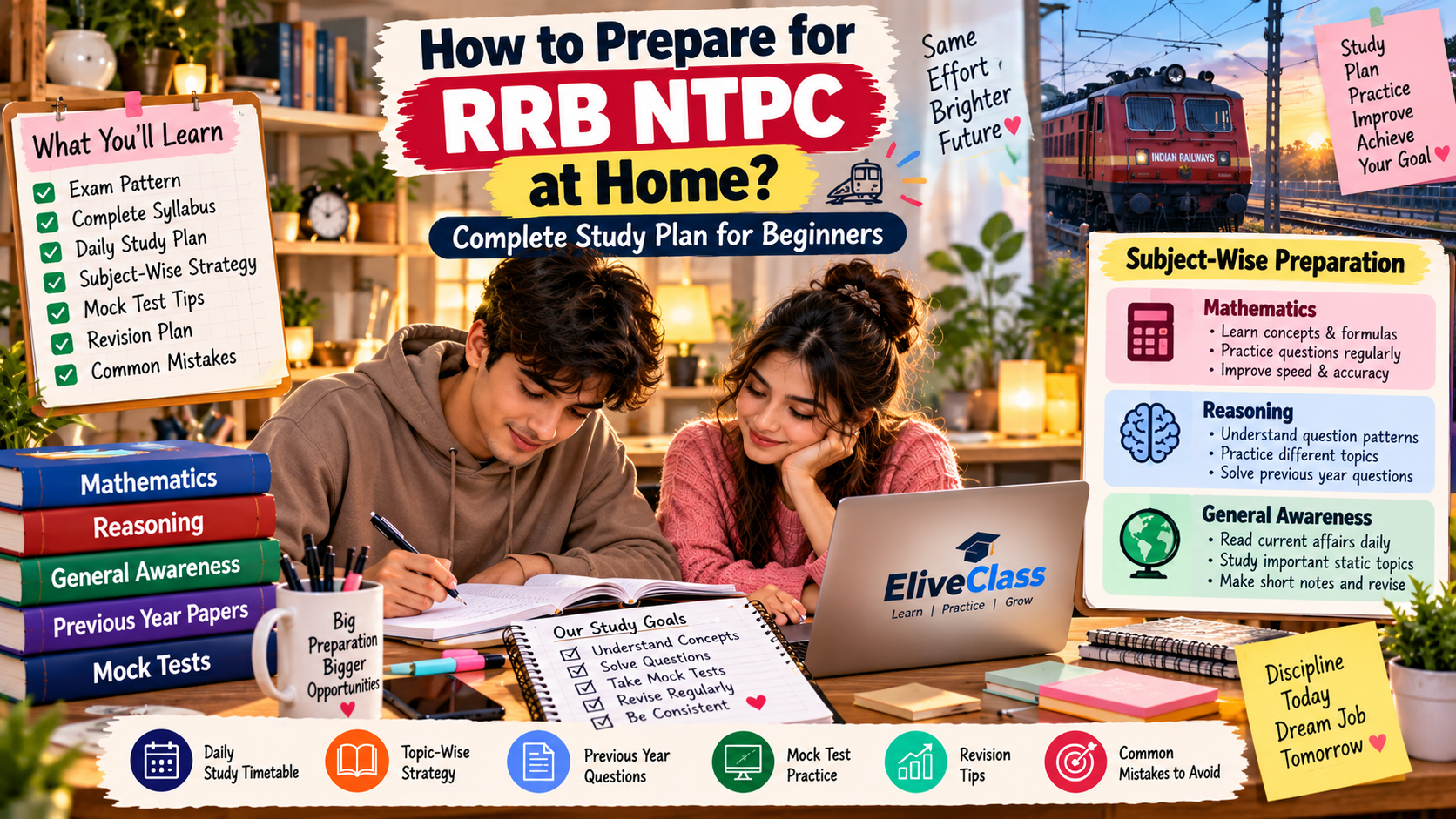
Preparing for the Railway Recruitment Board Non-Technical Popular Categories (RRB NTPC) exam at home can be an effective and affordable way to work toward a railway career. With a clear study plan, the right learning resources, regular practice, and consistent revision, candidates can prepare without joining expensive coaching classes.
However, studying at home requires discipline and a structured approach. You need to understand the syllabus, identify important topics, practise questions, and evaluate your progress regularly.
In this guide, we will explain how to prepare for RRB NTPC at home, including the syllabus, daily timetable, subject-wise preparation strategy, and mock-test tips.
1. Understand the RRB NTPC Exam Pattern
Before starting your preparation, understand the examination stages and syllabus for the recruitment cycle you are targeting.
RRB NTPC recruitment generally includes Computer-Based Test (CBT) stages. Depending on the post, additional stages may include a Computer-Based Aptitude Test (CBAT), a Typing Skill Test (TST), document verification, and a medical examination.
The CBT examinations commonly assess candidates in three major areas:
- Mathematics
- General Intelligence and Reasoning
- General Awareness
The number of questions, examination duration, negative marking, and selection stages may differ according to the applicable recruitment notification. Always consult the latest official RRB notification for accurate details.
2. Know the Complete RRB NTPC Syllabus
Understanding the syllabus helps you divide your preparation into manageable topics and avoid spending too much time on less relevant material.
Mathematics
Important topics include:
- Number System
- Percentage
- Ratio and Proportion
- Profit and Loss
- Simple and Compound Interest
- Time and Work
- Time and Distance
- Average
- LCM and HCF
- Mensuration
- Algebra
- Geometry and Trigonometry
- Elementary Statistics
General Intelligence and Reasoning
Focus on topics such as:
- Analogies
- Coding and Decoding
- Number and Alphabetical Series
- Mathematical Operations
- Syllogism
- Venn Diagrams
- Puzzles
- Relationships
- Analytical Reasoning
- Data Sufficiency
- Statement and Conclusion
General Awareness
Prepare topics including:
- Current Affairs
- Indian History
- Indian Geography
- Indian Polity
- Indian Economy
- General Science
- Sports and Important Events
- Indian Culture
- Computers and Basic Applications
- Scientific and Technological Developments
Make a checklist of these topics and mark each one as not started, in progress, or completed.
3. Create a Daily Study Timetable
A realistic timetable helps you balance all three subjects without becoming overwhelmed. Beginners can start with three to four focused hours daily and increase study time according to their schedule.
Here is a sample timetable for home preparation.
| Time | Study Activity |
|---|---|
| 1 hour | Mathematics concepts and practice |
| 45 minutes | Reasoning questions |
| 45 minutes | General Awareness and current affairs |
| 30 minutes | Revision and formula practice |
| 30 minutes | Mock test or timed practice questions |
Take short breaks between sessions when needed. If you have more time available, use it to revise difficult topics or solve additional questions.
Consistency matters more than following an unrealistic schedule for a few days.
4. Prepare Mathematics Step by Step
Mathematics can become easier when you understand the basic concepts before moving to advanced questions.
Start with topics such as number systems, percentages, averages, ratios, and simplification. Learn the relevant formulas and solve a few examples before attempting questions independently.
After understanding a topic, practise questions of increasing difficulty. Maintain a notebook containing important formulas, shortcuts, and mistakes you frequently make.
For example, if you struggle with time and work questions, revise the basic method and solve several similar problems before moving to the next topic.
You can also use EliveClass Mathematics practice resources to strengthen your understanding and assess your progress.
5. Improve Your Reasoning Skills Through Practice
Reasoning questions test your logical thinking and ability to identify patterns. Regular practice can help you recognize common question types and solve them more efficiently.
Begin with series, analogies, coding-decoding, and relationships. Gradually move to puzzles, syllogisms, and other topics.
When solving a question, focus on understanding the logic rather than memorizing an answer. If you answer incorrectly, review the explanation and attempt a similar question.
Set aside time for timed reasoning practice to improve both speed and accuracy.
6. Study General Awareness Every Day
General Awareness covers a broad range of subjects, so studying it regularly is more effective than trying to memorize everything shortly before the examination.
Divide your preparation into static General Knowledge, General Science, and current affairs.
Study one or two static topics daily and revise previously learned information. Follow a reliable current-affairs source and make short notes about important events.
Practice quizzes to test your memory. Pay particular attention to topics you repeatedly forget, and revise them at regular intervals.
7. Take RRB NTPC Mock Tests Regularly
Mock tests are an important part of preparing for RRB NTPC at home. They allow you to practise under timed conditions and become familiar with the examination format.
Start with topic-wise tests after completing individual subjects. Once you have covered enough of the syllabus, begin attempting full-length mock tests.
After every test, analyse your performance by asking:
- Which questions did I answer incorrectly?
- Which topics took too much time?
- Which questions could I have solved more accurately?
- Which topics need additional revision?
- Did I manage my time effectively?
Do not focus only on your score. Understanding your mistakes and correcting them is essential for making progress.
EliveClass.com provides RRB NTPC mock tests and practice resources that you can use alongside your regular study schedule.
8. Use Previous-Year Question Papers
Previous-year question papers help you understand the types of questions asked in earlier examinations and practise applying concepts in an exam-oriented way.
Solve them after covering the relevant topics. When possible, attempt a paper under timed conditions and review every incorrect answer.
Remember that previous-year questions are useful for practice, but they cannot guarantee that the same questions or topic distribution will appear in a future examination.
9. Follow a Weekly Revision Plan
Revision helps you retain information and identify topics that require further study.
At the end of each week, review the Mathematics formulas you learned, solve reasoning questions from previously studied topics, and revise General Awareness notes.
You can also take a sectional test to check your progress. If a topic remains difficult, revisit the concept instead of repeatedly attempting questions without understanding the solution.
Keep one day or part of a day for reviewing your weekly performance and planning the following week.
10. Avoid Common Preparation Mistakes
Candidates preparing at home should avoid these common mistakes:
- Studying without checking the official syllabus.
- Using too many books and online resources.
- Ignoring weak subjects.
- Memorizing formulas without practising questions.
- Taking mock tests without analysing mistakes.
- Studying current affairs without revising them.
- Following an unrealistic timetable.
- Ignoring sleep and taking insufficient breaks.
Choose a manageable set of reliable resources and use them consistently.
Prepare for RRB NTPC with EliveClass
Preparing for RRB NTPC at home becomes more manageable when your learning resources, practice questions, and revision schedule are organized.
EliveClass.com offers educational resources to support candidates preparing for railway examinations, including RRB NTPC mock tests and practice questions.
Use these resources to practise different question types, identify your weak areas, and track your improvement. Combine online practice with the official syllabus, previous-year papers, and regular revision to develop a balanced preparation strategy.
Conclusion
Preparing for RRB NTPC at home is possible with a structured timetable, a clear understanding of the syllabus, and consistent practice.
Start by understanding the examination pattern, divide your preparation into Mathematics, Reasoning, and General Awareness, and revise regularly. Use mock tests and previous-year question papers to evaluate your progress and improve your time management.
Most importantly, remain consistent and focus on learning from your mistakes. Explore the RRB NTPC preparation resources available on EliveClass.com and take a practical step toward your railway exam preparation goals.