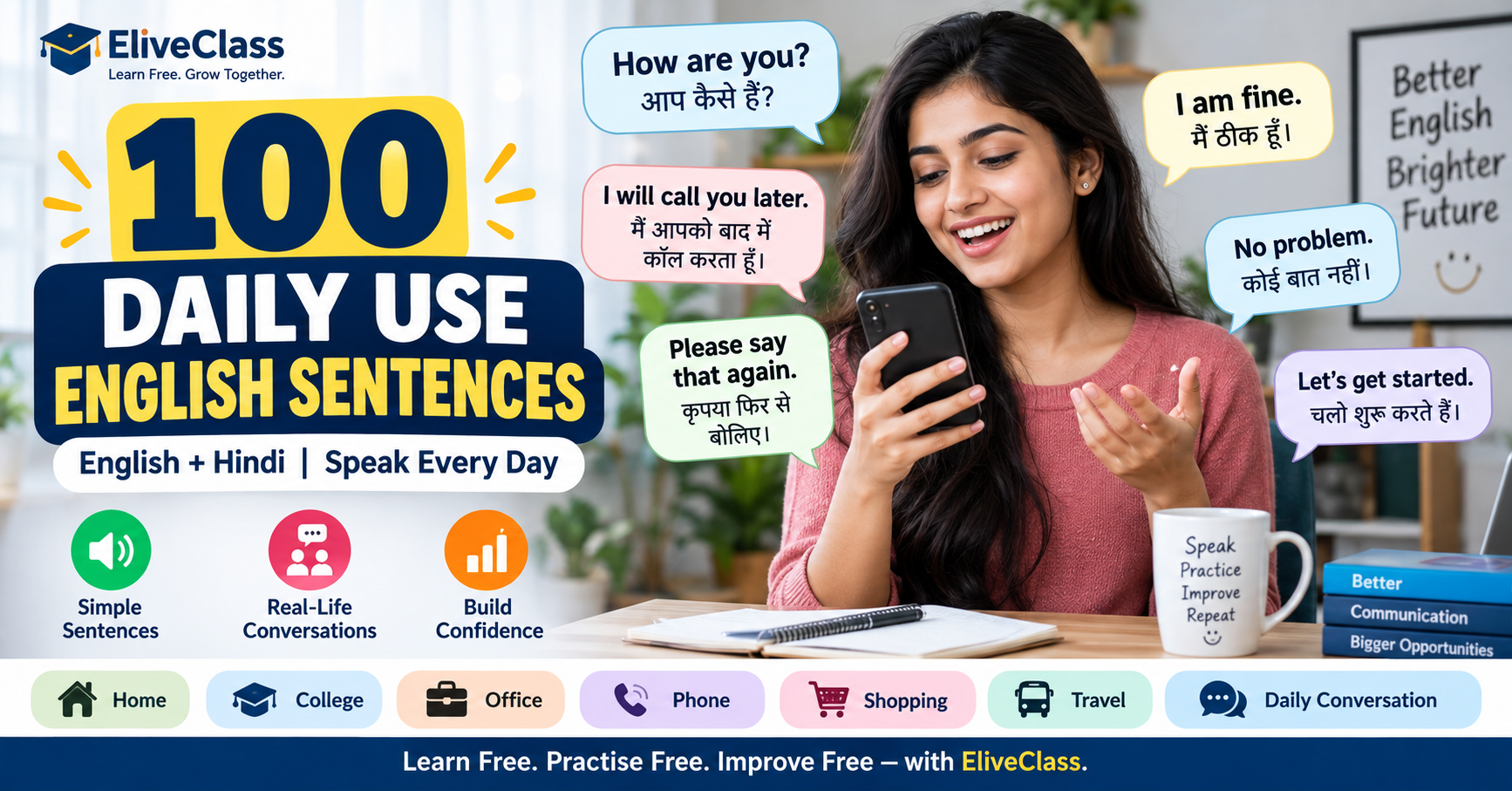
Do you understand English but hesitate when you have to speak it?
You are not alone. Many Hindi-speaking learners understand basic English grammar and vocabulary but struggle to form sentences quickly during real conversations. The best way to overcome this hesitation is to practise daily use English sentences that you can actually use at home, college, office, while shopping, travelling, or talking on the phone.
In this lesson, you will learn 100 daily use English sentences with Hindi meaning. The sentences are divided into different real-life situations so that you can practise them easily.
How to practise
Read the Hindi sentence → try to say it in English → check the answer → speak it aloud three times → use it in a real conversation.
You don’t need to memorise all 100 sentences in one day. Practising just 10 sentences every day can make your English-speaking practice much easier.
Quick Start: 10 English Sentences You Can Use Today
Hindi| English
आप कैसे हैं?| How are you?
मैं ठीक हूँ।| I am fine.
आप कहाँ जा रहे हैं?| Where are you going?
एक मिनट रुकिए।| Wait a minute.
मुझे समझ नहीं आया।| I didn’t understand.
कृपया फिर से बोलिए।| Please say that again.
कोई बात नहीं।| No problem.
मुझे थोड़ा समय चाहिए।| I need some time.
मैं अभी व्यस्त हूँ।| I am busy right now.
फिर मिलते हैं।| See you again.
Don’t just read these sentences silently.
Say each sentence aloud.
English speaking improves when you actually produce English instead of only reading or recognising it.
How to Use These Daily English Sentences
Follow these five simple steps:
1. Read the Hindi sentence.
2. Try to translate it aloud without looking at the answer.
3. Compare your answer with the natural English sentence.
4. Repeat the correct sentence three times.
5. Try to use the sentence during a real conversation.
If you practise 10 sentences every day, you can complete all 100 sentences in just 10 days.
«Practice formula: Read → Hide → Speak → Check → Repeat»
1. Greetings and Meeting People
1. नमस्ते, आप कैसे हैं?
Hello, how are you?
2. मैं ठीक हूँ, धन्यवाद।
I am fine, thank you.
3. आपसे मिलकर अच्छा लगा।
Nice to meet you.
4. बहुत समय बाद मिले।
Long time no see.
5. आपका दिन कैसा रहा?
How was your day?
6. सब कैसा चल रहा है?
How is everything going?
7. अपना ख्याल रखिए।
Take care of yourself.
8. फिर मिलते हैं।
See you again.
9. आपका स्वागत है।
You are welcome.
10. आपका बहुत-बहुत धन्यवाद।
Thank you very much.
Speak Now
Try saying these without looking at the English:
– आप कैसे हैं?
– आपसे मिलकर अच्छा लगा।
– अपना ख्याल रखिए।
If you hesitate, repeat these 10 sentences once more.
2. English Sentences Used at Home
11. दरवाज़ा बंद कर दो।
Close the door.
12. खिड़की खोल दो।
Open the window.
13. लाइट बंद कर दो।
Turn off the light.
14. मुझे एक गिलास पानी चाहिए।
I need a glass of water.
15. खाना तैयार है।
The food is ready.
16. मुझे भूख लगी है।
I am hungry.
17. मुझे प्यास लगी है।
I am thirsty.
18. मैं थोड़ी देर में आता हूँ।
I will be back in a while.
19. जल्दी तैयार हो जाओ।
Get ready quickly.
20. अपना कमरा साफ कर लो।
Clean your room.
Common Mistake
Hindi से English को word-for-word translate करने से कई बार unnatural sentences बन जाते हैं.
For example:
❌ I am feeling hunger.
A natural everyday sentence is:
✅ I am hungry.
The goal is not to translate every Hindi word separately. Learn English as complete phrases and sentences.
3. Questions We Ask Every Day
21. आप कहाँ जा रहे हैं?
Where are you going?
22. आप क्या कर रहे हैं?
What are you doing?
23. आप कब आए?
When did you come?
24. आप किसका इंतज़ार कर रहे हैं?
Who are you waiting for?
25. आप क्या चाहते हैं?
What do you want?
26. क्या आप मेरी मदद कर सकते हैं?
Can you help me?
27. क्या आप तैयार हैं?
Are you ready?
28. क्या आपको समझ आया?
Did you understand?
29. क्या मैं अंदर आ सकता हूँ?
May I come in?
30. क्या मैं आपसे कुछ पूछ सकता हूँ?
May I ask you something?
Mini Speaking Practice
Answer this question aloud:
Where are you going?
You could say:
I am going to the market.
Now change the destination:
– I am going to college.
– I am going to the office.
– I am going home.
– I am going to the shop.
One sentence pattern can help you create many real conversations.
4. When You Don’t Understand English
These sentences are particularly useful for English beginners. You don’t need perfect English to continue a conversation.
31. मुझे समझ नहीं आया।
I didn’t understand.
32. कृपया फिर से बोलिए।
Please say that again.
33. थोड़ा धीरे बोलिए।
Please speak a little slowly.
34. इसका क्या मतलब है?
What does this mean?
35. इसे अंग्रेज़ी में क्या कहते हैं?
What do you call this in English?
36. क्या आप इसे समझा सकते हैं?
Can you explain this?
37. मुझे यह शब्द नहीं पता।
I don’t know this word.
38. मैं सीख रहा हूँ।
I am learning.
39. मेरी अंग्रेज़ी अभी बहुत अच्छी नहीं है।
My English is not very good yet.
40. मुझे थोड़ा समय दीजिए।
Give me a little time.
Notice the word “yet” in sentence 39.
«My English is not very good yet.»
“Yet” suggests that your English can improve with practice.
5. School and College English
41. आज हमारी क्लास कितने बजे है?
What time is our class today?
42. क्या आपने अपना होमवर्क किया?
Did you do your homework?
43. मुझे यह सवाल समझ नहीं आया।
I didn’t understand this question.
44. कृपया इसे समझाइए।
Please explain it.
45. मैं कल अनुपस्थित था।
I was absent yesterday.
46. क्या मैं आपकी नोटबुक देख सकता हूँ?
Can I see your notebook?
47. परीक्षा कब है?
When is the exam?
48. मुझे थोड़ा और अभ्यास करना है।
I need to practise a little more.
49. मुझे इसका उत्तर पता है।
I know the answer.
50. चलो साथ में पढ़ते हैं।
Let’s study together.
EliveClass Practice Tip
If you are a student or preparing for competitive exams, don’t completely separate your English practice from your regular studies.
Spend a few minutes every day speaking English alongside your other preparation. Consistent practice can gradually improve both confidence and communication.
6. Office and Workplace English
51. मैं अभी व्यस्त हूँ।
I am busy right now.
52. मैं आपको बाद में कॉल करता हूँ।
I will call you later.
53. मीटिंग कितने बजे है?
What time is the meeting?
54. मैंने काम पूरा कर लिया है।
I have completed the work.
55. मुझे थोड़ा और समय चाहिए।
I need a little more time.
56. कृपया मुझे विवरण भेज दीजिए।
Please send me the details.
57. मैं इसे आज पूरा कर दूँगा।
I will complete it today.
58. क्या हम इस पर बाद में बात कर सकते हैं?
Can we discuss this later?
59. मैं आपकी बात समझता हूँ।
I understand your point.
60. यह एक अच्छा विचार है।
That’s a good idea.
Make Your Workplace English More Polite
Instead of simply saying:
❌ Send me details.
You can say:
✅ Please send me the details.
Small changes like please, could, and would can make your workplace communication sound more polite and professional.
7. Phone and WhatsApp Conversations
61. हेलो, कौन बोल रहा है?
Hello, who is speaking?
62. क्या आप मुझे सुन सकते हैं?
Can you hear me?
63. आपकी आवाज़ साफ नहीं आ रही है।
I can’t hear you clearly.
64. एक मिनट रुकिए।
Hold on for a minute.
65. मैं आपको वापस कॉल करता हूँ।
I will call you back.
66. मुझे आपका मैसेज मिल गया।
I received your message.
67. मैंने आपको मैसेज भेज दिया है।
I have sent you a message.
68. कृपया लोकेशन भेज दीजिए।
Please send me the location.
69. मैं अभी बात नहीं कर सकता।
I can’t talk right now.
70. हम बाद में बात करते हैं।
Let’s talk later.
8. Shopping and Market English
71. यह कितने का है?
How much is this?
72. यह बहुत महंगा है।
This is too expensive.
73. क्या आपके पास दूसरा रंग है?
Do you have another colour?
74. क्या आपके पास बड़ा साइज़ है?
Do you have a bigger size?
75. मैं सिर्फ देख रहा हूँ।
I am just looking.
76. मुझे यह पसंद है।
I like this.
77. क्या मैं इसे ट्राई कर सकता हूँ?
Can I try this?
78. क्या आप थोड़ा कम कर सकते हैं?
Can you reduce the price a little?
79. मैं इसे ले लूँगा।
I will take it.
80. मुझे बिल दीजिए, कृपया।
Please give me the bill.
9. Travel and Directions
81. स्टेशन कहाँ है?
Where is the station?
82. वहाँ कैसे जाएँ?
How do I get there?
83. क्या यह रास्ता सही है?
Is this the right way?
84. यहाँ से कितनी दूर है?
How far is it from here?
85. मुझे टैक्सी चाहिए।
I need a taxi.
86. बस कब आएगी?
When will the bus arrive?
87. मुझे यहाँ उतरना है।
I need to get off here.
88. कृपया मुझे यहाँ छोड़ दीजिए।
Please drop me here.
89. मुझे देर हो रही है।
I am getting late.
90. हम लगभग पहुँच गए हैं।
We are almost there.
10. Feelings, Opinions and Everyday Responses
91. मुझे खुशी है।
I am happy.
92. मैं थोड़ा थका हुआ हूँ।
I am a little tired.
93. चिंता मत करो।
Don’t worry.
94. कोई बात नहीं।
No problem.
95. मुझे ऐसा नहीं लगता।
I don’t think so.
96. आप सही हैं।
You are right.
97. मैं आपसे सहमत हूँ।
I agree with you.
98. मुझे यकीन नहीं है।
I am not sure.
99. यह बहुत अच्छा है।
That’s great.
100. चलो शुरू करते हैं।
Let’s get started.
Don’t Try to Memorise All 100 Sentences in One Day
Reading these 100 sentences once won’t automatically make you fluent.
Instead, follow a simple 10-day English speaking challenge.
Day| Practice
Day 1| Sentences 1–10
Day 2| Sentences 11–20 + revise 1–10
Day 3| Sentences 21–30
Day 4| Sentences 31–40
Day 5| Sentences 41–50
Day 6| Sentences 51–60
Day 7| Sentences 61–70
Day 8| Sentences 71–80
Day 9| Sentences 81–90
Day 10| Sentences 91–100 + full revision
For every group, use this method:
Read → Hide → Speak → Check → Repeat
The goal isn’t to memorise sentences mechanically. The goal is to make these sentence patterns easier to produce when you need them in real life.
5-Minute English Speaking Challenge
After completing today’s sentences, try this five-minute activity.
Minute 1: Introduce Yourself
Say:
My name is _____.
I live in _____.
I am a student.
or
I work as _____.
I am learning English because _____.
Minute 2: Talk About Your Day
Describe what you did today.
For example:
I woke up at 7 o’clock. I had breakfast. Then I went to college.
Minute 3: Talk About Your Family
Try describing your family using simple English.
Minute 4: Talk About Tomorrow
Say what you plan to do tomorrow.
For example:
Tomorrow, I will go to the office. I will complete my work and meet my friend.
Minute 5: Review Your Mistakes
Think about the sentences where you hesitated.
Repeat those sentences again.
If possible, record yourself on your phone. Don’t worry about having a perfect accent. Instead, listen for:
– Long pauses
– Missing words
– Incorrect tenses
– Repeated grammar mistakes
– Sentences that are difficult to form
These become your next practice targets.
Quick Quiz: Test Your English
Question 1
“मुझे समझ नहीं आया।” का सही English sentence कौन-सा है?
A. I am not understand.
B. I didn’t understand.
C. I no understood.
D. I haven’t understand.
Answer: B. I didn’t understand.
Question 2
Choose the correct sentence:
A. I am agree with you.
B. I agree with you.
C. I agreeing with you.
D. I am agreed you.
Answer: B. I agree with you.
“Agree” is used as the verb here, so we don’t normally say “I am agree.”
Question 3
How would you politely ask someone to repeat something?
A. Speak again.
B. Again say.
C. Please say that again.
D. You say one more.
Answer: C. Please say that again.
Question 4
Translate:
“मैं आपको बाद में कॉल करता हूँ।”
Answer: I will call you later.
Question 5
Translate:
“क्या मैं आपसे कुछ पूछ सकता हूँ?”
Answer: May I ask you something?
What Should You Learn After These 100 Sentences?
These daily-use sentences are a great starting point, but speaking English confidently involves more than memorising sentences.
You should gradually work on:
– Sentence formation
– Tenses
– Vocabulary
– Listening
– Pronunciation
– Questions and answers
– Everyday conversation
– Regular speaking practice
That’s why sentence practice works best when combined with structured English learning.
Continue Learning English Free with EliveClass
If you want to move beyond individual sentences and learn English systematically, explore the EliveClass Free English Speaking Course.
The beginner course covers areas such as greetings, professions, family relationships, everyday questions, vocabulary, nouns, pronouns, adjectives, prepositions and practice quizzes.
Start English Speaking Part 1 Free
After learning the basics, you can continue with more advanced concepts including tenses, active and passive voice, modal verbs, conditionals, phrasal verbs and additional practice.
Today’s English-Speaking Rule
Don’t try to speak advanced English.
Try to speak simple English without hesitation.
Ten useful sentences spoken confidently are more valuable than 100 difficult words that you never use.
Start with the first 10 sentences today.
Say them aloud.
Use at least three of them in a real conversation.
Then return tomorrow and practise the next 10.
With regular practice, simple sentences can gradually become natural parts of your everyday English.
Learn Free. Practise Free. Improve Free — with EliveClass