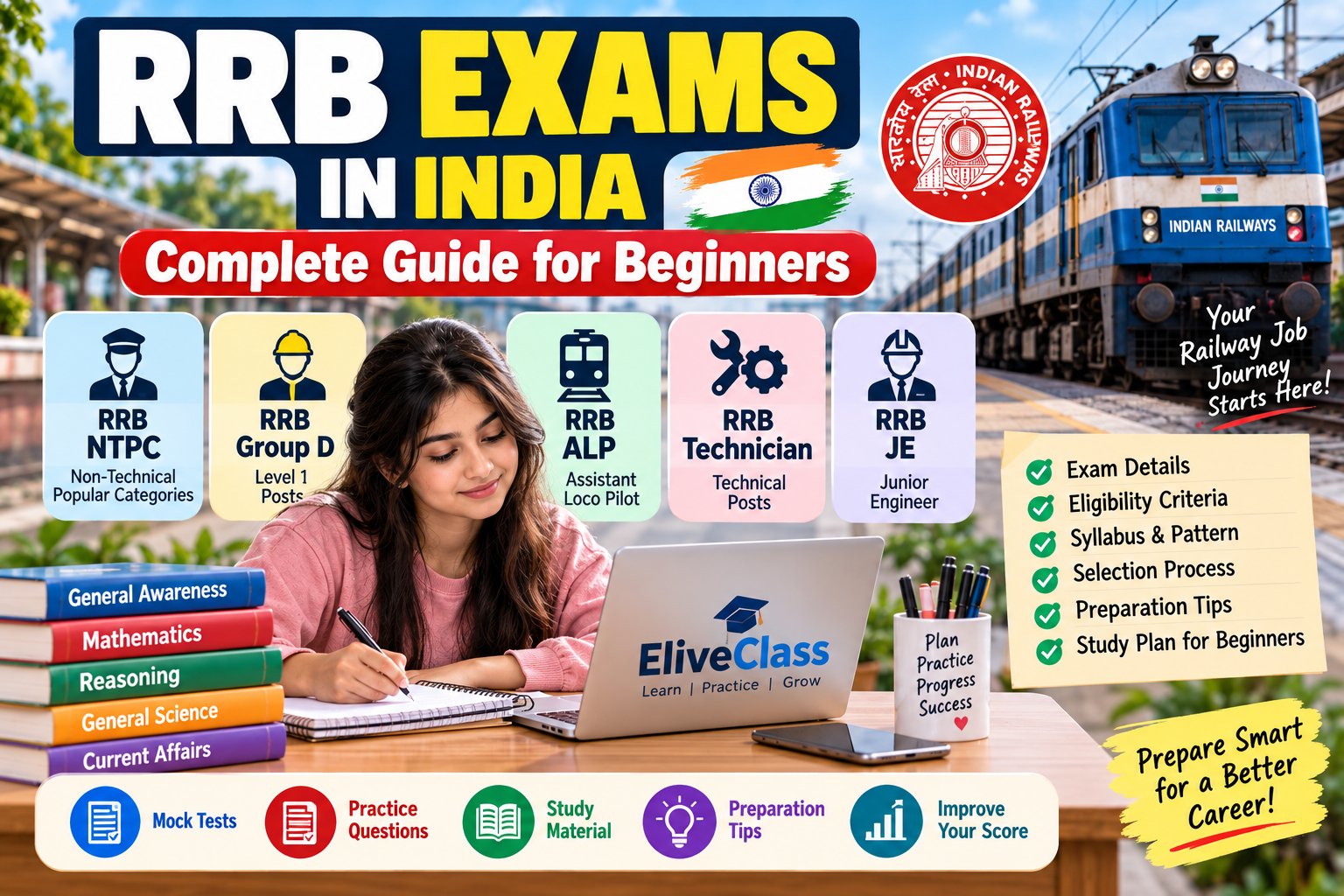
Railway jobs are among the popular career choices for candidates in India because they offer a range of employment opportunities across different educational qualifications. The Railway Recruitment Boards (RRBs) conduct recruitment examinations for various positions in Indian Railways, including undergraduate and graduate-level non-technical posts, technical positions, and Group D roles.
If you are planning to prepare for a railway examination, understanding the different RRB exams, eligibility criteria, syllabus, exam pattern, and selection process is an important first step. This guide explains everything beginners need to know to start their preparation effectively.
What Are RRB Exams?
RRB stands for Railway Recruitment Board. These boards recruit eligible candidates for various posts in Indian Railways through competitive examinations and other selection stages.
Different railway recruitment notifications have different educational requirements, age limits, exam patterns, and selection procedures. Candidates should always read the official notification for the specific recruitment they want to apply for.
Major RRB Exams in India
Here are some of the major railway recruitment examinations candidates can explore.
1. RRB NTPC Exam
RRB NTPC stands for Railway Recruitment Board Non-Technical Popular Categories. It covers various non-technical positions, depending on the recruitment notification.
Some examples of posts advertised under NTPC recruitment include:
- Junior Clerk cum Typist
- Accounts Clerk cum Typist
- Station Master
- Goods Train Manager
- Senior Clerk cum Typist
The posts available depend on the specific recruitment cycle and eligibility requirements.
The selection process generally includes computer-based tests, with additional aptitude or typing tests for certain posts, followed by applicable verification and medical requirements.
2. RRB Group D Exam
RRB Group D recruitment is intended for eligible candidates applying for various railway Level 1 positions.
Examples of roles advertised in Level 1 recruitment may include Track Maintainer and different assistant positions in railway departments.
The selection process generally involves a Computer-Based Test (CBT), followed by Physical Efficiency Test (PET), document verification, and medical examination, as specified in the applicable notification.
Candidates should check the official eligibility criteria before applying.
3. RRB ALP Exam
RRB ALP stands for Assistant Loco Pilot. This recruitment is designed for candidates who meet the prescribed technical educational qualifications.
Depending on the notification, candidates may need relevant ITI, diploma, or other specified technical qualifications.
The selection process generally involves multiple computer-based test stages, an aptitude test where applicable, document verification, and medical fitness requirements.
4. RRB Technician Exam
RRB Technician recruitment covers technical positions in railway departments.
Eligibility depends on the technician post and may include specified educational qualifications, ITI qualifications, or other technical credentials.
The syllabus and selection stages vary according to the recruitment notification. Candidates should carefully review the post-wise requirements before beginning preparation.
5. RRB JE Exam
RRB JE stands for Railway Recruitment Board Junior Engineer. It is intended for candidates who meet the prescribed engineering-related qualifications for the advertised posts.
Depending on the post, eligible candidates may need an engineering diploma, degree, or another qualification specified in the notification.
The examination typically includes computer-based test stages, followed by document verification and medical examination as applicable.
RRB Exam Eligibility Criteria
RRB eligibility requirements differ across recruitment categories. Before applying, candidates should check the following details.
Educational qualification: Some posts require a Class 10 qualification or ITI, while others require Class 12, graduation, or a relevant technical qualification.
Age limit: The minimum and maximum age limits depend on the post and recruitment notification. Applicable age relaxations may be available for eligible categories according to government rules.
Nationality: Candidates must satisfy the nationality and other eligibility conditions specified in the official notification.
Medical standards: Certain railway posts have specific medical and visual standards, particularly for safety-related duties.
Never assume that eligibility for one RRB examination automatically makes you eligible for another.
RRB Exam Syllabus and Pattern
The syllabus varies depending on the examination. However, several railway recruitment exams include some common subjects.
Mathematics
Important topics may include:
- Number System
- Percentage
- Ratio and Proportion
- Profit and Loss
- Time and Work
- Time and Distance
- Average
- Simple and Compound Interest
- Mensuration
General Intelligence and Reasoning
Common topics may include:
- Number and Alphabetical Series
- Coding and Decoding
- Analogies
- Syllogism
- Venn Diagrams
- Puzzles
- Relationships
- Mathematical Operations
General Awareness and General Science
Depending on the examination, candidates may need to study:
- Current Affairs
- Indian History and Geography
- Indian Polity
- Indian Economy
- General Science
- Sports and Important Events
- Scientific and Technological Developments
Technical examinations may also include trade-specific or engineering-related subjects.
Important: The number of questions, examination duration, marking scheme, negative marking, and selection stages differ between RRB recruitment categories. Always use the latest official notification to confirm the exact pattern for your chosen exam.
How to Prepare for RRB Exams as a Beginner
Preparing for railway examinations becomes easier when you follow a structured study plan.
1. Choose the Right Examination
First, identify the recruitment category that matches your educational qualifications and career goals. Review the eligibility criteria, syllabus, and selection process.
2. Understand the Complete Syllabus
Download or review the official syllabus for your chosen examination. Divide the subjects into smaller topics and prepare a realistic daily timetable.
3. Build Your Basic Concepts
Start with fundamental concepts in Mathematics, Reasoning, and General Awareness. Candidates preparing for technical posts should also allocate sufficient time to their relevant technical subjects.
4. Practice Questions Regularly
Solving practice questions helps you understand question patterns, identify weak areas, and improve accuracy. Begin with topic-wise questions before moving to full-length tests.
5. Take Mock Tests
Mock tests are useful for practising under exam-like conditions. They help you manage time, understand your current performance, and identify topics that require more revision.
After every mock test, review incorrect answers and understand the reason behind each mistake.
6. Revise and Track Your Progress
Reserve time each week to revise formulas, important facts, reasoning methods, and previously studied topics. Track your mock test scores to measure improvement over time.
Prepare for RRB Exams with EliveClass
If you are preparing for railway recruitment examinations, EliveClass.com provides learning resources to support your preparation.
Candidates can explore RRB NTPC and RRB Group D practice questions, mock tests, and other educational resources to strengthen their understanding of important topics.
Use these resources alongside the official syllabus, previous-year question papers, and regular revision to build a more effective preparation routine.
Whether you are starting from the basics or revising for an upcoming examination, consistent practice can help you identify your strengths and work on your weaker areas.
Conclusion
RRB exams offer different railway career opportunities for candidates with varied educational qualifications. Popular recruitment categories include RRB NTPC, RRB Group D, RRB ALP, RRB Technician, and RRB JE.
To begin your preparation, select the right examination, understand its eligibility criteria, study the official syllabus, and practise regularly through questions and mock tests.
Visit EliveClass.com to explore relevant railway exam preparation resources and take the next step toward your learning goals. Remember to check official RRB notifications for the latest recruitment dates, vacancies, eligibility conditions, and examination details.